


Integrated Planning Manual
Introduction
Section I: Fullerton College and North Orange County Community College District
Section II: Fullerton College Participatory Governance and Decision-Making
- Overview
- The Governance Structure
- General Principles for Participatory Governance
- Fullerton College Participatory Governance Decision-Making Process
- Membership in Particpatory Governance Groups
- Recommendations
- Fullerton College Councils and Committees
- Protocols for Fullerton College Participatory Governance Committees
Section III: Integrated Planning and Decision Making
- Overview
- Fullerton College Integrated Planning Model
- Detailed Campus-wide Planning Process
- Review of College Mission Statement
- College Goals, Objectives, and Strategic Action Plans
- Strategic Action Plan Implementation
- Budget Allocation
- Assessment of Planning and Decision-Making Processes
- College Annual Reports to the Community
- Additional Selection Processes
Introduction
The Fullerton College Integrated Planning Manual describes the integrated institutional planning processes at the College and how constituent groups participate in such processes. In addition, the document outlines the College’s participatory governance structures to further the transparency, inclusion, and collaboration in the decision-making processes. The manual begins with a description of the North Orange County Community College District’s (NOCCCD) mission and planning, followed by a description of Fullerton College’s specific planning processes and governance structures.
Timeline for Integrated Planning Manual Review
As a living document that reflects a dynamic educational institution, the document is updated as needed by the President’s Advisory Council (PAC). While updates may occur at any time, the periodic review of this document is initiated and coordinated by PAC. This document will be reviewed according to the following three-year cycle:
- Annually: Updates and/or clarifications to roles, committees, and processes
- Every three years: Full document review
The review is announced by the President’s Advisory Council and feedback is solicited according to this cycle. Changes requested outside of this cycle will be considered by PAC on a case-by-case basis.
In order to preserve the reliability of the Fullerton College Integrated Planning Manual, the college’s Director of the Office of Institutional Effectiveness will be responsible for collaborating with PAC to steward updates of the document, including the changing processes, timelines, and/or committees. It is the responsibility of the college community and its leaders to communicate to PAC any such changes to be included in the manual as they occur throughout the year.
Section I: Fullerton College and the North Orange County Community College District
Participatory governance at Fullerton College is achieved in the spirit of cooperation, collaboration, and collegiality. It promotes the vision and values of the College and ensures their achievement through appropriate policies and procedures via a structure of councils, committees, and task forces. The model is grounded in Assembly Bill 1725 and in the policies of the North Orange County Community College District Board Policy 2510.
The purpose of the Fullerton College participatory governance structure is to provide each constituent group the opportunity to participate in the planning process and program initiatives as well as to develop, review, and revise policies and procedures through their representatives.
Functionally, this is accomplished by councils, committees, and task forces created to formalize and facilitate collegial communication, and to resolve issues as close to the point of origin as possible. These structures provide an opportunity for all perspectives of constituent group interests to be considered. The result is effective processes for planning, implementation, evaluation, and planning agenda(s) for improvement, as well as a transparent process of decision-making.
The North Orange County Community College District
As part of the North Orange County Community College District (NOCCCD), Fullerton College’s planning processes link to district-level planning in two ways:
-
- The District Strategic Directions, in alignment with the District Mission Statement, establish the district-wide goals. The College then develops site- specific goals, objectives, and action plans that contribute to the advancement of the District Mission and to the long-term Educational and Facilities Master Plan.
- Assessment of progress on the District Strategic Directions, goals, and objectives as well as college goals and objectives are completed on a regular basis.
NOCCCD Mission Statement
The North Orange County Community College District cultivates an equitable learning and working environment to empower our students and employees to reach their full potential. We serve our community by providing exemplary academic programs and support services that foster student growth and attainment of educational, professional, and personal goals.
Cypress College and Fullerton College will offer associate and baccalaureate degrees, career and technical education (vocational) certificates, and transfer education, as well as developmental instruction and a broad array of specialized training. North Orange Continuing Education will offer non-college credit programs including high school diploma completion, basic skills, career and technical education (vocational) certificates, and self-development courses. Specific activities in both the Colleges and North Orange Continuing Education will be directed toward promoting personal enrichment, civic engagement, and sustainable economic development.
District-wide Planning: Educational and Facilities Master Plan and the Strategic Plan
The North Orange County Community College District Educational and Facilities Master Plan is meant to guide NOCCCD through a ten-year period. As part of the long-term plan, the Educational and Facilities Master Plan outlines the District Strategic Directions, which are institutional goals and, as such, are broad statements that articulate how NOCCCD intends to address current and anticipated challenges. The most recent Educational and Facilities Master Plan 2021 – 2030 was approved by the Board of Trustees in July 2020. A “refresh” of the plan was completed in December of 2023, which included changes to capital projects in response to the COVID-19 pandemic.
District Strategic Directions
These Strategic Directions and Goals are intended to guide the development of each program, project, or initiative within the District for the next ten years:
Student Experience and Success
NOCCCD will provide comprehensive support, equitable opportunities, co- curricular programming, and clear pathways to ensure that students achieve their educational and career goals.
Employee Experience
NOCCCD will provide an inclusive, equitable, and welcoming environment to support the well-being and professional growth of all employees.
Stewardship of Resources
NOCCCD will promote a shared vision of responsible stewardship of District resources through transparent and inclusive decision-making and integrated planning.
Collective Impact and Partnerships
NOCCCD will develop and sustain collaborative projects and partnerships with educational institutions, community-based organizations, and businesses to create positive change in the region.
Physical Environment
NOCCCD will be a leader in creating both accessible and resilient facilities and well-designed flexible learning opportunities that utilize up-to-date technology and processes to support student and employee success.
District-wide Strategic Plan
The North Orange County Community College District-wide Strategic Plan is NOCCCD’s short-term plan. This plan includes District Objectives and District Action Plans that describe how the District Strategic Directions, identified in the Educational and Facilities Master Plan, will be achieved.
In the Strategic Plan, the District Objectives detail the initiatives to be undertaken which require collaboration and coordination among District Services and campus administrators, faculty, and staff. The Strategic Plan also identifies who will be responsible for implementing the action plans, offers a timeline for implementing the action items, and details the outcomes and measures that will support in assessing the impact on student success and institutional effectiveness. The most recent Strategic Plan, which is revised every few years, describes short term plans and goals for the 2022-2026 timeframe.
The NOCCCD integrated planning model depicts how the components in the District-wide planning process link to one another in a cycle of evaluation, development of goals and objectives, resource allocation, plan implementation and re-evaluation. In this way, NOCCCD planning practices demonstrate institutional effectiveness and a cycle of continuous quality improvement.
Research is central to the NOCCCD integrated planning model because plans are developed based on data and plan outcomes are assessed using quantitative and qualitative data. In addition to research, the other components of the NOCCCD integrated planning model are as follows.
-
- The NOCCCD Mission Statement describes the intended student population and the services that NOCCCD provides to the community. As such, this statement is the touchstone for all planning processes.
- NOCCCD analyzes demographics to foresee challenges and opportunities (external scans) and compares its current status to the NOCCCD Mission Statement (internal scans) to develop a long-term Comprehensive Master Plan that includes both educational and facilities plans.
- Based on what is learned through the preparation of the Comprehensive Master Plan, District Strategic Directions are collaboratively developed and then approved by the Board of Trustees to serve as institutional goals that articulate how NOCCCD intends to address current and anticipated challenges.
- The District-wide Strategic Plan uses the District Strategic Directions (institutional goals) to derive District Objectives. The District Objectives describe specific initiatives to be undertaken to achieve the District Strategic Directions that require collaboration and coordination among District services and campus administrators, faculty, and staff. The initiatives to be undertaken at each site intended to contribute to the achievement of the District Strategic Directions are documented in the campus Strategic Plans and in the District Services Administrative Reviews.
- The District Services Administrative Review includes a thorough analysis of data and a plan for each District Service. This process tracks the efforts of each District Service to continually improve the quality of the services provided by District Services to the campuses and to other District Services.
- District resources are allocated based on the process outlined in the North Orange County Community College District Budget Allocation Handbook. Each campus and District Service then allocates resources based on its Strategic Plan and local process. In addition, the Strategic Planning Fund is used to fund initiatives related to the District Strategic Directions and District-wide Strategic Plan.
- Once resources are allocated, District Services and the campuses implement the plans as developed at the local site and identified in the site Strategic Plans.
- NOCCCD assesses in two ways: (1) regular assessment of progress on the District Strategic Directions and District Objectives and (2) assessment of planning and decision-making processes on a three-year cycle (minimum). The assessments inform the Strategic Plans and the District Services Administrative Review.
Section II: Fullerton College Participatory Governance and Decision-Making
Participatory governance at Fullerton College is achieved in the spirit of cooperation, collaboration, and collegiality. It promotes the vision and values of the College and ensures their achievement through appropriate policies and procedures via a structure of councils, committees, and task forces. The model is grounded in Assembly Bill 1725 and in the policies of the North Orange County Community College District Board Policy 2510.
The purpose of the Fullerton College participatory governance structure is to provide each constituent group the opportunity to participate in the planning process and program initiatives as well as to develop, review, and revise policies and procedures through their representatives.
Functionally, this is accomplished by councils, committees, and task forces created to formalize and facilitate collegial communication, and to resolve issues as close to the point of origin as possible. These structures provide an opportunity for all perspectives of constituent group interests to be considered. The result is effective processes for planning, implementation, evaluation, and planning agenda(s) for improvement, as well as a transparent process of decision-making.
Governance Structure
Roles of the Participants in Shared Governance
College President
The College President represents the Governing Board. The President and is responsible for final decisions after consultation with all appropriate constituencies. The President is responsible for providing communication procedures and the infrastructure for achieving participation from all constituencies in the decision- making processes appropriate to participatory governance. The President encourages the participation of all constituencies in their appropriate participatory governance roles.
Faculty Senate
The Faculty Senate represents the faculty of Fullerton College in academic and professional matters. Consistent with AB1725 and other District policies, the President consults collegially with the Faculty Senate on academic and professional matters. The Senate expresses the view of the faculty through a vote of the Senate. At the Senate’s discretion, the Senate may choose to delegate its responsibility to specific committees or to individual faculty members for limited duration and purposes.
The College President relies on the Faculty Senate on academic and professional matters in accord with provisions of Title 5 of the California Code of Regulations (refer to Fullerton College Participatory Governance Decision-Making Process above). The Faculty Senate makes all faculty appointments to college governance committees. Appointees are expected to regularly attend meetings and to contribute as a part of their professional responsibilities. The faculty members serving on those committees are participating to represent and express the interests of (1) the Senate and (2) their constituents. Appointees do not make decisions for the Senate and are obligated to communicate regularly to the Senate and their representative groups on the governance committee’s activities.
Deans of Fullerton College
The Deans of Fullerton College are educational leaders who guide the work of the various divisions of the College. Deans serve on various committees representing their areas of expertise and the College administration. Deans are responsible for influencing and implementing strategies for student success through the establishment of new activities or the revision of existing activities.
In addition to their work on committees, Deans hold regular meetings with faculty and staff in their individual divisions. Each of the Deans also meets with the Vice President of Instruction or the Vice President of Student Services, providing opportunities for idea sharing and promotion of new programs or procedures, which may be shared with the President for implementation and funding. Deans make decisions within their respective Divisions, make recommendations concerning hiring of personnel, ensure adherence to legal and ethical standards and policies established by the Board of Trustees, and implement best practices and courses of action.
Managers of Fullerton College
The managers of Fullerton College serve a variety of supervisory roles throughout the campus. Managers asked to serve on College committees or the President’s Advisory Council represent their individual areas of expertise as well as the opinion of the managers as a whole. The role of managers in making decisions at the College is determined by the scope of responsibility and authority delegated in job descriptions for their positions.
General Principles for Participatory Governance
- All decision-making is based on recognition that the College exists to educate students.
- All constituent groups have a vested interest and a role in ensuring that Fullerton College fulfills the mission defined by the legislature, State Board of Governors, and the North Orange County Community College District Board of Trustees.
- Participatory governance is a method of organized and collegial interaction in which faculty, staff, students, and managers participate in thoughtful deliberation and decision-making, leading to recommendations made to the College President
- Mutual agreement is the goal to be achieved through active participation and collegial interaction by all constituent groups.
- The most effective means of developing policies and procedures is to provide opportunity for involvement by the constituent groups affected by the implementation of these policies and procedures.
- In academic and professional matters, as defined by AB1725, the College President will rely on the advice of the Faculty Senate in reaching mutual agreement.
- Representatives of constituent groups involved in the participatory governance process have the responsibility of keeping their respective groups informed of the proceedings and recommendations of governance groups, and communicating concerns and recommendations from membership of their constituent groups.
- Individuals not serving as representatives have the opportunity to share concerns with their constituent groups, with the anticipation that their views will be represented in governance councils, committees, and task forces.
Fullerton College Participatory Governance Decision-Making Processes
Fullerton College values the perspectives and contributions of all constituents in our campus community. For academic and professional matters as outlined in AB 1725, Fullerton College depends on the Faculty Senate to provide leadership, perspectives, and recommendations on items that fall within these areas:
- Curriculum including establishing prerequisites and placing courses within disciplines
- Degree and certificate requirements
- Grading policies
- Educational program development
- Standards or policies regarding student preparation and success
- District and college governance structures, as related to faculty roles
- Faculty roles and involvement in accreditation processing processes, including self-study and annual reports
- Policies for faculty professional development activities
- Processes for program review
- Processes for institutional planning and budget development
- Others academic and professional matters as are mutually agreed upon between the governing board and the academic senate.
Fullerton College will “rely primarily” on the Faculty Senate for matters 1, 2, 3, 5, 7, 8 above.* Fullerton College administrators will seek to reach “mutual agreement” with the Faculty Senate on matters 4, 6, 9, 10, 11 above.** (AP 2510)
When the college is considering a change that potentially affects any of the 10+1 areas, the President engages the Faculty Senate, President’s Advisory Council, and other appropriate constituent groups in the decision-making process.
The President initially discusses the proposed change with the Faculty Senate leadership and appropriate department/division faculty and manager(s) in an effort to identify any issues, concerns, or suggestions pertaining to the topic. Next, the President, the Senate leadership, and appropriate department/division faculty and manager(s) work to develop a consensus on the merits of the rationale for the proposed change, including its nature and scope. Then the President, Senate leadership, and appropriate department/division faculty and manager(s) develop multiple approaches to the concern or idea.
The President, Senate leadership, and appropriate department/division faculty and manager(s) then gather information on the potential consequences of each of the approaches. The President subsequently brings options to Faculty Senate, PAC, and other appropriate groups for consultation and action consistent with the participatory governance process.
Following appropriate consultation, the President makes a decision about whether or not a change will be implemented, and if so, which option among those identified is best for the college. If the college community finds—through established processes and procedures—that the impact of a decision has negative or undesirable consequences, that decision may be revisited.
* With respect to those areas of academic and professional matters for which the Board of Trustees will rely primarily upon the recommendations of the senate(s), if a recommendation is not accepted, the Board of Trustees or its designee, upon request of the senate(s), shall communicate its reasons in writing to the academic senate(s) (AP 2510 2.1.2). When rely primarily, the recommendation of the Academic Senate will normally be accepted, and only in exceptional circumstances and for compelling reasons will they not be accepted (Title 5 §53200 (d)).
** In instances where the Board of Trustees [or its designee] elects to provide for mutual agreement with the senate(s), and agreement has not been reached, existing policy shall remain in effect unless continuing with such policy exposes the District to legal liability or causes substantial fiscal hardship. In cases where there is no existing policy, or in cases where the exposure to legal liability or substantial fiscal hardship requires existing policy to be changed, the Board of Trustees may act, after a good faith effort to reach agreement, for compelling legal, fiscal, or organizational reasons (AP 2510 2.2.3 and Title 5 §53200 (d)).
Responsibilities of All Parties
Participatory governance committee deliberations and actions should be public. In addition to representation afforded to individuals through constituent groups, individuals and groups may also be heard by any council, committee, or task force by requesting permission to speak.
The final authority for governance at Fullerton College is the North Orange County Community College District Board of Trustees. The Board of Trustees delegates authority to the President through the District Chancellor. The President and all constituent groups are committed to a functional and effective participatory governance process.
Membership in Participatory Governance Groups
Fullerton College faculty, staff, students, deans, and managers serve on a variety of college, constituent group and district councils, committees, and task forces.
Members of the governance groups of the college are determined by constituent groups. When the appointment is to be made based on the position held by the individual, the specific position is identified in the composition of the group. When the individual is appointed or elected to represent a constituent group, the following processes are followed:
Faculty Senate Appointments – All faculty appointments are made through the Faculty Senate.
Classified Appointments – All Classified appointments are accomplished by the collaboration of the Classified Senate through the CSEA appointment process.
Student Appointments – All student appointments are made through the Associated Students.
Deans and Managers Appointments – All deans and managers appointments are made by the College President after consultation with the Vice Presidents.
Appointments – Appointments of membership will generally be made in April/May to fill positions which will be vacated the subsequent year. Appointments may be otherwise made at any time deemed appropriate by the participatory governance group.
Recommendations
Recommendations from College Committees and/or their Subcommittees Recommendations coming from college committees and/or their subcommittees will be directed to the appropriate administrator. The latter may accept the recommendation, accept the recommendation with modifications, or reject the recommendation. If a recommendation is rejected or modified, a rational will be provided. Whichever decision is made will be reflected in the committee’s minutes.
Recommendations from Faculty Senate Committees
Official recommendations from Faculty Senate, which may include recommendations Faculty Senate has received from one of its subcommittees, will be reflected in the Faculty Senate minutes and directed to the appropriate administrator in writing. The administrator will: 1) accept the recommendation; 2) accept the recommendation with modifications; or 3) reject the recommendation. If the administrator is modifying or rejecting the recommendation, the administrator will prepare a written response to Faculty Senate providing the rationale for the decision.
Fullerton College Councils and Committees
President’s Advisory Council
The President’s Advisory Council (PAC) serves as the central, participatory governance council of the college. The purpose of PAC is to receive and review college policy recommendations from any and all college groups, to obtain constituent opinions, to advise the College President regarding policy recommendations, to provide a venue for college wide initiatives, and to provide a means of communication with the college community. The PAC is the forum in which all proposed broad-based college procedural changes are discussed collegially before they are acted on or implemented by the College President.
Specialized projects are referred by the Council to other governance organizations for review, such as the Faculty Senate and the Deans’ Council for instructional matters, the Classified Senate for classified issues and the Associated Students for student issues. These bodies report to the Council with recommendations. The President’s Advisory Council (PAC) strives to integrate all aspects of communication, decision-making and planning tasks. The PAC establishes committees to assist with specialized projects.
Faculty Senate
The Fullerton College (FC) Faculty Senate represents faculty interests and views in academic and professional matters in the College and District. The Faculty Senate makes recommendations to the College President, and acts as the committee on committees, establishing faculty representation on College and District committees. Any full-time faculty member is eligible to serve on the Faculty Senate. The FC Faculty Senate derives its power and responsibilities from Title 5 of the California Education Code. As representatives of the faculty, the FC Faculty Senate makes recommendations to the college and district with respect to academic and professional matters, the so-called “10+1.
A complete list of committees that report to PAC, Faculty Senate, as well as dual reporting committees is provided on the Fullerton College Committee webpage
Definition of Recommending Groups
Council – A council meets on a regular basis and is composed of constituency representatives designated or selected to act in an advisory capacity. A council often directs the work of numerous committees or task forces.
Standing Committee – A standing committee is composed of constituency representatives and considers matters pertaining to a designated charge or subject. A committee reports its recommendations to appropriate representative bodies.
Committee – All governance bodies may establish their own committees to support their work. All committees should have a defined purpose. If desired, governance units may request membership from other constituent units to serve as resource members. Resource members will be assigned as defined under “Membership.” The President’s Advisory Council may establish committees with overarching purpose on topics that are also being reviewed from the perspective of a particular constituent unit.
Protocols for Fullerton College Participatory Governance Committees
All participatory governance committees at Fullerton College use a common set of protocols for meetings and information sharing. These protocols help ensure that committees regularly and systematically assess their effectiveness.
Protocols Regarding Meetings:
Suggested protocols for the first meeting of the fall:
- Review mission. If revisions are made, recommend revised mission statement to appropriate body for approval (PAC and/or Faculty Senate)
- Determine how the committee will work during the upcoming academic year toward its mission (i.e., set goals)
- Publish meeting dates and locations (room number or Zoom link) for the upcoming semester/academic year, to the degree possible
- Provide a current roster of committee members and their terms
- Assign responsibilities to members (e.g., notetaker)
- Clarify roles and duties of committee members
Ongoing protocols
- To the degree possible, publish agendas 72 hours in advance of each meeting (required of Brown Act committees)
- Take minutes/meeting notes at each meeting that include actions taken and/or decisions made
- To the degree possible, publish minutes/meeting notes within one week of approval
- Maintain updated roster of committee members
At the end of each academic year, or whenever appropriate for the committee, committees should:
- Review the goals for that year as a committee
- Provide a written report on the progress of those goals to the appropriate body (PAC and/or Faculty Senate). The committee chair will also attend a PAC and/or Faculty Senate meeting to answer questions about the written report.
Administrative Support of Committees:
- Fullerton College maintains a webpage where a directory of shared governance committees is available. The directory provides rosters, meeting schedules, agendas, and minutes or notes for each committee.
- Committees may choose to have their own public-facing website that contains meeting schedules, rosters, minutes and agendas. If committees choose to maintain their own sites, they will be linked to in the directory.
Meeting schedules, rosters, minutes and agendas may be emailed to committees fullcoll.edu to be uploaded.
Section III: Integrated Planning and Decision Making
Fullerton College Integrated Planning Model
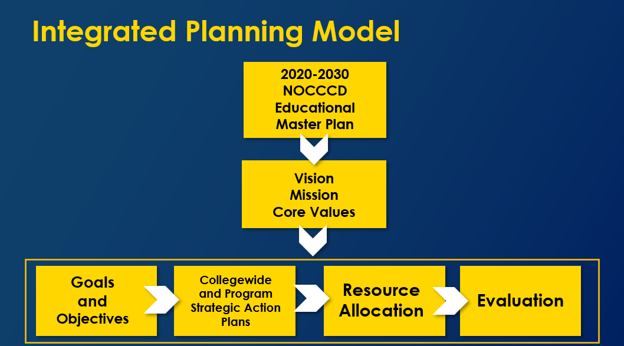
The Fullerton College integrated planning model describes the components in the college planning process as well as the systems used to link the components to one another in a cycle including the development of goals and objectives, resource allocation, plan implementation and evaluation. These planning processes demonstrate institutional effectiveness and a cycle of continuous quality improvement.
Detailed Campus-wide Planning Process
The Fullerton College campus-wide planning process chart below provides a more detailed look at how planning decisions are made in the participatory governance process of the College.
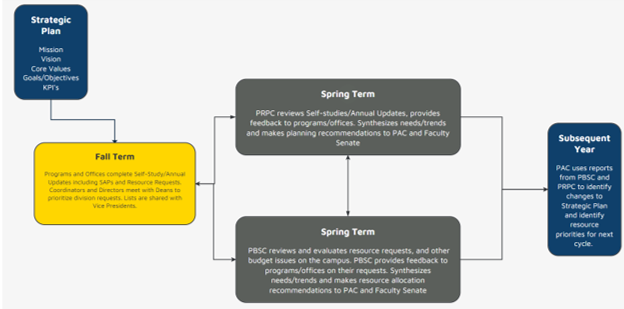
Programs develop Strategic Action Plans (SAPs) in their comprehensive program review self-studies, completed every four years after a thorough self-reflective process using disaggregated student enrollment, retention, and success data provided by the Office of Institutional Effectiveness. PRPC reviews and provides feedback on SAPs to programs. Concurrently, the Planning and Budget Steering Committee (PBSC) considers resource requests associated with SAPs and makes recommendations to PAC and Faculty Senate regarding which requests should be prioritized for funding.
In years two, three, and four of the program review process, programs complete annual updates on SAPs. Programs may communicate completion of or changes to plans, and they have the opportunity to request additional funds if needed. Program review annual updates are reviewed by PRPC. Additional resource requests are considered by PBSC. Both committees complete annual reports to Faculty Senate and the President’s Advisory Council with themes present in comprehensive program review annual updates and annual updates.
Program Review and Planning
PRPC promotes and supports the systematic self-assessment of instructional programs, student support services, and administrative/operational areas throughout the college. To that end, PRPC designs comprehensive program review self-study and annual update documents, reads and evaluates self-studies, and provides feedback to writers.
A key purpose of the committee is to identify common themes found across the various self-studies and annual updates. The themes identified by the committee are presented to both the Faculty Senate the President’s Advisory Council (PAC) for endorsement so that they may inform the College’s planning process. PRPC provides the identified themes, a list of short and long-term goals, and a complete list of requested resources associated with SAPS and operational needs.
PRPC also reviews, evaluates, and provides feedback on SAPs developed in comprehensive program review self-studies and reported on in annual updates. The feedback given to programs is also shared with PBSC to be considered as they make recommendations for resource allocations.
As part of a continuous quality improvement process, the committee engages in ongoing review and revision of templates and processes involved in program review. Members serve staggered terms (when feasible) with one half the committee elected, appointed, or selected recently for each program review cycle. PRPC reports to the Faculty Senate and the PAC.
Program review operates on a four-year cycle. There are separate reporting forms for Instructional Programs and Student Support and Administrative and Operational Services programs. Throughout the four-year cycle, the PRPC makes improvements to the reporting templates and makes recommendations to improve the process of reporting and planning.
PRPC also serves as the participatory governance body that works with the Office of Institutional Effectiveness to develop and evaluate the college’s strategic plan, including the mission statement, vision, values, goals, and objectives. This process happens every four years, the year before instructional programs engage in comprehensive program review self-studies so all program SAPs that are established in the comprehensive self-studies can be aligned to the college-wide strategic plan.
Timeline and Process for Program Review
- August – October: Programs and departments complete the comprehensive program review self-studies or annual updates depending on where they are in the four-year program review cycle
- November: Self-study draft reports are given to immediate management supervisors for review
- December: Immediate Management Supervisors submit program review final reports to PRPC
- February-April: Reading and review of self-study reports is done by PRPC and evaluations of SAPs are shared with PBSC for their use in considering resource requests
- May: Annual summary report of themes from program review comprehensive self-studies and/or annual updates is presented to Faculty Senate and PAC.
Review of College Mission Statement
The President’s Advisory Council (PAC) is the shared governance body responsible for endorsing the mission statement or recommending revisions. All constituent groups represented at PAC review the college mission statement every four years in alignment with the college’s strategic planning process. The Program Review and Planning Committee (PRPC) guides the college’s process for revising the mission statement and strategic plan.
College Goals, Objectives, and Strategic Action Plans
In concert with the NOCCCD District-wide Strategic Directions and following the College’s campus planning processes, Fullerton College establishes its goals, objectives, and strategic action plans. The college goals are reviewed by the President’s Advisory Council on the same schedule as the mission statement and college Strategic Plan. At that time, the goals are either endorsed by PAC or suggestions for modification are recommended.
While the college goals are less likely to change from year to year, the objectives pertinent to each goal may change. The objectives provide greater specificity for how the College may accomplish its goals.
Fullerton College Goals, Objectives, and Institution Set Standards
Goal 1: Equity in Access
-
- Objective 1: Expand equitable access to Dual Enrollment pathway programs and courses.
- Objective 2: Equitably increase college enrollment by reducing equity gaps for Black/African American applicants.
Goal 2: Equity in Support
-
- Objective 1: Increase usage of basic needs support for food, housing, transportation, mental and physical health, childcare, and technology.
- Objective 2: Equitably increase the number of students completing comprehensive educational plans.
- Objective 3: Increase access to affordable course materials.
- Objective 4: Increase equitable usage of academic support services.
- Objective 5: Increase equitable usage of apprenticeship, fellowship, internship, and job placement programs.
Goal 3: Equity in Success
-
- Objective 1: Equitably increase first-year English and math completion by reducing equity gaps for Latina/o/x/e and Black/African American students.
- Objective 2: Equitably increase term to term persistence by reducing equity gaps for Black/African American students.
- Objective 3: Equitably increase degree/certificate completion by reducing equity gaps for Black/African American students.
- Objective 4: Equitably increase transfer attainment by reducing equity gaps for Latina/o/x/e and Black/African American students.
- Objective 5: Equitably increase the percentage of graduates earning a living wage.
Key Performance Indicators (Institution Set Standards)
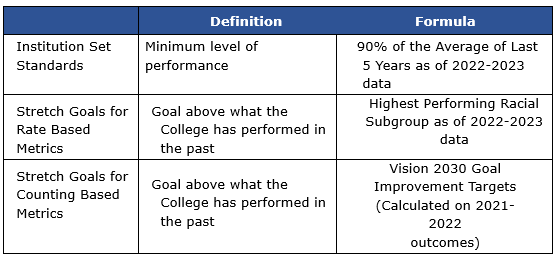
Institution-set standards are the minimum level of performance set internally by institutions to meet educational quality and institutional effectiveness expectations. Standards reflect the “floor” or “baseline” levels of satisfactory performance of student learning and achievement below which the institution does not want to fall. The stretch standard represents a goal above what the College has performed in the past and are “aspirational” in nature.
Currently Fullerton College defines set and aspirational standards as such:
The metrics it uses to track progress on its standards and aspirational goals are as follows:
- Successful Enrollment After Completing Application
- Course Success Rates
- Completion of English in First Year
- Completion of Math in First Year
- Persistence from Fall to Spring in First Year
- Attained a Living Wage After Exiting System (No Transfer)
- Earned a Certificate
- Earned an Associate Degree
- Transfers to Four-year Universities
- Average Number of Units Completed by Associate Degree Earners
- Percentage of first-time students who complete a comprehensive educational plan by the end of their first year
Strategic Action Plan Implementation
The strategic action plans, developed by individual areas to address the objectives, detail concrete activities and initiatives which will advance the College towards its intended goals.
Through the development of the college’s strategic action plans, a department, program, or group is assigned responsibility for planning, completion, and evaluation of a particular strategic action plan. Strategic action plans are defined as measurable activities designed to achieve a particular objective. Those responsible for individual action plans will:
- Manage the timelines for the plan component
- Develop appropriate processes
- Identify and address funding needs through available resources
- Provide data and other types of evidence to assess the levels of success following plan implementation
- Document the activities and outcomes to contribute to the preparation of the annual Progress Report
To ensure the continual improvement and progress towards the College goals, the strategic action plans are designated for two years and are evaluated and modified annually, as needed. The process for establishing two-year objectives and strategic action plans begins in September of even-numbered years and is completed in February of odd-numbered years. Progress on the current strategic action plans is collected annually in August and incorporated into the college’s annual report to the community in November.
Given the importance of these elements in the planning process, it is important to use a common definition of terms. Thus, this Integrated Planning Manual clarifies that “objectives” are the outcomes we are looking for to reach the “goals,” and the “strategic action plans” are the activities we undertake to achieve the outcomes.
Budget Allocation
The Planning and Budget Steering Committee (PBSC) is a subcommittee of Faculty Senate and the President’s Advisory Council (PAC). The purpose of PBSC is to make recommendations to PAC regarding planning and matters related to Fullerton College fiscal resources, which include:
- Making recommendations regarding one-time and ongoing budget requests, including requests for emergency funding and funding for strategic action plans
- Reviewing and considering funding requests submitted in program review self-studies and annual updates
- Supporting efforts to investigate and deliberate external funding sources
- Generating and sharing information on budget structure, budget development, and budget issues
Within the NOCCCD, Fullerton College has autonomy to determine local employee staffing contingent on collaboration among NOCCCD leaders and approval of the Chancellor as well as the development of unique budgets for expenditures from general and categorical funds in the following categories:
- Hourly employees;
- Supplies and materials;
- Services and other operating expenses, such as travel; and
- Capital outlay, such as equipment
The revenue available to the college to fund the categories listed above comes from the operating allocation, self-supported funds, or restricted funds. The operating allocation consists of funds provided for discretionary expenditures which include supplies, equipment, services, and non-classified hourly staff. Self-supported funds exist in areas that operate with the assumptions that the resources generated will remain within the area to cover related expenditures. Examples of self-supported areas include facility rentals and the production center. Restricted funds are those in which the revenue must be spent in the manner prescribed by regulation, such as health services, parking, restricted lottery, veterans’ services, and other categorically funded programs.
Unrestricted available resources from carry-over funds are available to fund additional activities, including requests for resources coming from the program review process and strategic action plans.
Through the program review process, programs identify resources necessary to undertake Strategic Action Plans (SAPs) aligned with the college’s strategic plan. PBSC considers resource requests associated with SAPs and makes recommendations to the President’s Advisory Council and Faculty Senate regarding funding. The PRPC and PBSC co-chairs also coordinate to collect resource requests associated with operational needs and forwards them to the college president and the president’s staff for budget planning.
Assessment of Planning and Decision-Making Processes
Assessment includes feedback from council and committee members serving on specific groups, as well as comments from faculty, staff, administrators, and students. The President’s Advisory Council (PAC) receives recommendations on modifications to the structure, format, or purpose of any of its subcommittees. The President considers the recommendations of PAC and approved changes are documented on the Fullerton College Committees website. The Faculty Senate is responsible for similar modifications to any of its subcommittees, and any changes will likewise be noted on the Fullerton College Committees website.
An integral piece of assessment of planning and decision-making processes at the College is accomplished by the Accreditation Steering Committee (ASC), which is a standing subcommittee of both the Faculty Senate and the President’s Advisory Council. Part of the ASC’s responsibility is to regularly evaluate and refer recommendations for improvement of the College’s policies, processes, practices, procedures, and publications to the appropriate bodies in order to ensure the integrity and effectiveness of the College’s planning and decision-making process and its alignment with the College’s mission and accreditation standards. The Program Review and Planning Committee’s (PRPC) functions also include reviewing the College’s Institutional Student Learning Outcome (ISLO) data and minimum performance standards (e.g., Institution-Set Standards) to further inform the College’s planning and decision-making processes.
College Annual Reports to the Community
Each year, the College produces annual reports to inform the community, on- campus and off, about progress toward achievement of the college goals and objectives. Currently, the College publishes an Institutional Effectiveness Report. The Institutional Effectiveness Report provides key measures and outcomes related to student enrollment and success, staff and community demographics, and it documents the changes to the planning and decision-making processes and structures that occurred throughout the year. In addition to publishing the Institutional Effectiveness Report, the Office of Institutional Effectiveness annually presents a highlight of major accomplishments to the Board of Trustees.
Additional Selection Processes
Building Design Approval Process
Background
Input from the ultimate users of new building projects and the renovation of existing buildings is essential to ensure buildings meet the needs and specifications of users.
Procedure
To help control costs and ensure that design specifications approved by user groups are not changed without input, review, and approval, the below approval procedure has been established relative to building design specifications developed by user groups.
-
- User group develops and approves building design specifications – Building design specifications and requirements need to be approved by the user group prior to being submitted to architects. To avoid project delays and increased architectural and construction costs, after the user group has agreed to the plan, there will be no more user-group initiated changes to the plan.
- Architect incorporates specifications approved by user group in project design – Design specifications approved by user group are incorporated into architectural designs. Architect signifies that specifications have been included in plans. If specifications are excluded by the architect, the architect notifies the user group.
- User group reviews and approves final architectural designs to ensure that specifications and requirements are successfully included in architectural plans. Assigned user group representatives sign off on plans to signify approval. The amount of time provided for review is to be agreed upon by the user group, administration, and the architectural firm. The assigned user group approver(s) is(are) to be determined by the user group.
- Subsequent changes require user group approval – If there are any new changes to a plan that has already been approved by the user group, then the user group must have the opportunity to review and approve the new changes.
Building User Groups Participant Selection Process
Background
Building User Groups (BUGs) are established to obtain input from intended users of new buildings and buildings undergoing renovation. Such input is essential to help ensure facilities meet the needs and specifications of intended users.
BUG Participant Selection Process
Depending on the building project, there can be a wide range of intended users. Certain buildings can have a narrow scope of users, while other buildings can have a broad range of users. The size of each BUG shall be determined by collaboration among the Vice President of Administrative Services (VPAS), deans, division faculty, and classified staff.
BUG participants shall represent constituency groups (faculty, students, classified staff, deans, and managers), especially from the departments or programs that will use the building.
BUGs shall be established by the VPAS, participatory governance groups, and deans with activities or operations in each respective building. Faculty Senate shall appoint faculty BUG members, CSEA shall appoint classified BUG members, and Associated Students (AS) Senate shall appoint student BUG members.
The VPAS must give affected faculty, staff, and deans at least two weeks’ notice that they are to choose BUG members. There must be at least two weeks between notification and the next Faculty Senate, CSEA, and AS Senate meetings, at which the BUG members shall be appointed.
Once the shared governance groups have appointed BUG members, the BUG shall determine a meeting schedule so that all BUG members can participate, with the understanding that attendance may vary due to members’ availability.
Faculty Hiring Prioritization Process
In the Fall semester, the Vice President of Instruction informs Deans of the open period to request new faculty hiring, and Deans then inform their division faculty. Departmental faculty collaborate on creating requests to hire full-time faculty. These requests are informed by institutional data provided by the Office of Institutional Effectiveness and are connected to the departmental goals and objectives established in the Program Review process.
All requests are submitted in writing to Division Deans on a standard form circulated by the Office of Institutional Effectiveness. The Vice President of Instruction convenes a meeting where requests are discussed and cooperatively ranked by the Deans. This ranking is forwarded to the Faculty Senate by way of the Vice President of Instruction.
In a parallel exercise, Faculty Senate ranks all requests. The office of the Vice President of Instruction provides the Faculty Senate President all requests submitted in writing along with the Deans’ rankings. The Faculty Senate President shares these materials with the Faculty Allocation Committee, which considers the requests and produces a recommended ranking. That recommended ranking is voted on by Faculty Senate. When Faculty Senate finalizes its rankings, they are shared with the College President.
The College President creates a final ranked list using the recommendations shared by Deans and the Faculty Senate. The College President’s final ranked list is forwarded to the NOCCCD and lastly returned to college administration, Faculty Senate, and divisions/departments. This process occurs each year even if no hiring is anticipated.
Process for Determining Reassigned-time Positions
There are two processes for determining reassigned-time positions: one for campus- wide positions that are associated with Faculty Senate committees or that report to the Faculty Senate and one for non-Senate positions.
For Senate and dual-reporting committees, or positions that report to the Faculty Senate, when a position is up for election, information will go out campus wide to all faculty through the standard Faculty Senate ballot process. Interested faculty will submit a letter of interest which would be distributed to senators, and elections would take place at a Senate meeting.
For reassigned time positions that are not associated with Faculty Senate, information about the position would also go out to all faculty through the president or their designee. Interested faculty will submit a letter of interest. A committee consisting of three faculty members appointed by Faculty Senate, the appropriate manager or dean, the appropriate Vice President, and one student appointed by Associated Students (AS) would interview applicants and make recommendations to the President. For the AS Advisor position, the committee will consist of four faculty members appointed by Faculty Senate, four students appointed by AS, an appropriate manager or dean, and the appropriate VP.
The chair term will be the same as the membership term. (If the position is not tied to committee—and so there is no membership term—then the term should be three years.)
Selection of Interim Deans
Selection committees will include eight members: three faculty from the division appointed by the Faculty Senate, one classified professional, one student, and three managers, including the College President. The College President ultimately has the final decision.
Selection of Interim Vice Presidents
Selection committees will include eight members: three faculty appointed by the Faculty Senate, one classified professional, one student, and three managers, including the College President. The College President ultimately has the final decision.